By Phoenix Bennett
IMO: Book 5/5. Movie 2.5/5
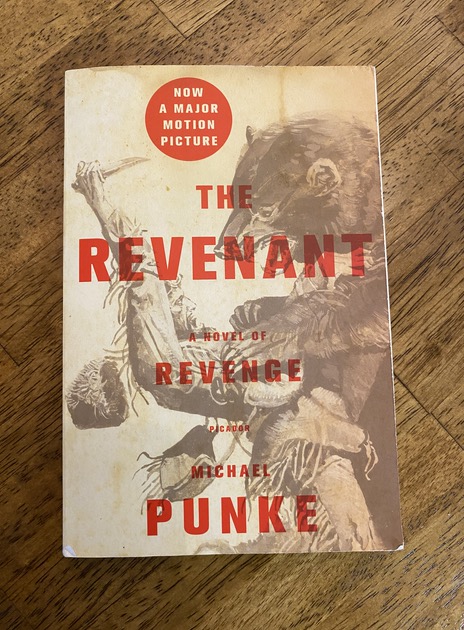
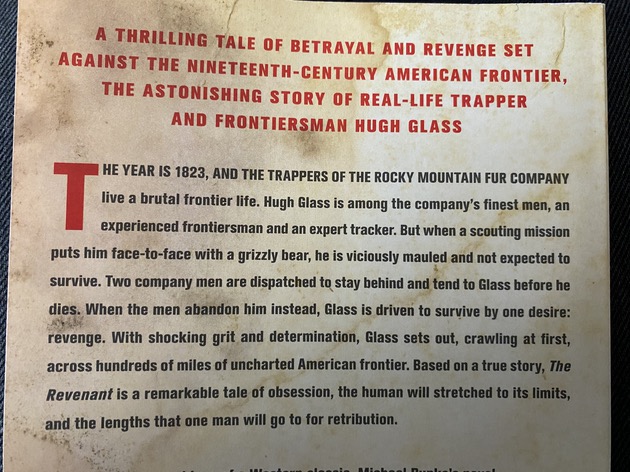
I watched The Revenant back when it was released in 2015. The craze over it was INSANE. Up until a few weeks ago when I re-watched it, I remembered very little, but I did remember thinking it did not lived up to the hype…and being slightly scarred as a 15 year-old watching the rape scene (more on that later). So, after getting the book as a souvenir in Wall, South Dakota, I decided to read the book and re-watch the movie after I had finished. And now I am here, collecting my thoughts by comparing the book and movie and all the little discrepancies that kind of irked me.
My all time favorite book in elementary school was The Captain’s Dog: My Journey with the Lewis and Clark Tribe by Roland Smith. I read it twice. I was NOT expecting The Revenant to give me nostalgia for that book. But it absolutely did and I absolutely fell in love with this book and the writing style. For some reason I went into reading The Revenant by Michael Punke hesitantly, worried that the writing would give Ye Olde English feels and it would be difficult to track. That was not at all the case. Descriptions were concise yet beautiful and powerful. The theme of revenge saturated the whole story without the author having to constantly remind us of Hugh Glass’s rage that drove him to struggle through America’s uncharted frontier. His descriptions of Glass’s actions did the talking for him. We could feel the main character’s hatred towards the two men, John Fitzgerald and Jim Bridger, that left him for dead in his post-grizzly attack state, stealing all of his belongings that were essential for survival. And this is precisely where my issues with the movie began.
A Reason For Revenge
In both the movie and book (and in real life since this is a true story), Hugh Glass was attacked by a grizzly bear while working for the Rocky Mountain Fur Company. John Fitzgerald and Jim Bridger volunteered to hang back with Glass until he died in order to give him a proper burial while the rest of their crew traveled on to Fort Union. The fur company was in a time crunch, needing to report back ASAP to the head honcho of the fur trade once they established themselves at Fort Union (a story line that was pretty much completely brushed over in the movie despite being a huge pressure and driver in the book and real life). In the movie, however, there was also another completely fictional character that stayed back with Glass: his son who was half indigenous American. There was a separate storyline that Glass had a wife and a son who were Native American. We constantly saw flashbacks of his wife who had been killed. She acted as a big motivator for him in the film. The real Hugh Glass did have a love interest who had died while he was away, and I saw him losing these loved ones as significant character development as we got to get a glimpse as to why anyone would want to venture into the frontier.
However, his biggest motivation for revenge in the film was when John Fitzgerald killed Glass’s son in front of his own eyes so that they could flee and catch up to the rest of their crew. Um…that’s a huge change and a much more drastic reason to seek revenge. Yet, I feel that the notion of craving revenge was not as strong as it was in the book…and his imaginary son didn’t even get killed, it was just over his prized gun and survival supplies! This could also be due to the fact that in a book you get a better glimpse in the characters’ minds, but still, the movie just didn’t do it for me and we really don’t get to see that anger until the end when he actually goes after Fitzgerald.
Hugh Glass as a Character
In the book, Hugh Glass was well-respected. He had a lifetime of experiences to back his skills needed for this journey, and he just so happened to be the Captain Andrew Henry’s favorite. Glass seemed to act as second-in-command. That is why him being attacked by a grizzly was so devastating for the crew, especially the captain. It was initially thought that one of the best men was lost.
In the movie, I did not see Hugh Glass as a dignified, well-respected man. One of the first scenes was Fitzgerald spewing insult after insult at him because he had a Native American son. He was made fun of because he was some sort of “Native American sympathizer.” Glass was quiet in the movie. He didn’t stick up or look out for the rest of the crew like he did in the book. Fitzgerald was hard-shelled and calculated in the book as well, picking on the younger, weaker men like Jim Bridger. Bridger respected Glass because he stood up for him when men like Fitzgerald came after him. This is why Bridger did not want to flee when Glass was injured, but also why Fitzgerald was able to take advantage of his weakness. A conflict that was nonexistent in the movie.
Setting
This is just a minor thing, but the setting seemed to be entirely in the Rocky Mountains in the movie. It was also snowy throughout the entire movie. The book took place along the Missouri River mostly and Hugh Glass was trying to meet up with the Rocky Mountain Fur Company BEFORE winter set in. That was constantly a worry of his in the book, and towards the end he did have some close calls because of the weather getting so bad. And I’m not sure exactly what month the movie would have started…but if it was in winter then grizzly bears should be hibernating. Additionally, because in the book it was warm when Glass first was mauled, he really struggled finding food. Glass got sick from meat/marrow that was roasting in the hot sun, and the flies were extremely bad.
Antagonists + Lingering Fear
The movie made the antagonists much more black-and-white than the book did. Obviously, the main antagonist was John Fitzgerald for being the leader in the abandonment of Hugh Glass (and the killing of his son in the movie). Jim Bridger’s antagonism was more grey in the book and virtually nonexistent in the movie. In the book, Bridger did abandon Glass and leave him with nothing, but we constantly saw glimpses of his regret. He also cared for Glass’s wounds and fed him even at the risk of Fitzgerald scolding him because he just wanted Glass to die already. Bridger only fled out of fear. A lapse of judgement that constantly had me wondering if he deserved the revenge Glass wanted to wreak upon him. But- if you are caught aiding in the crime, aren’t you just as deserving of punishment?
There was also a constant, lingering, look-over-your-shoulder type fear surrounding Native Americans in the book. The Arikara tribe was ruthless against the white men. But, there were also other tribes where their politics were changing depending on the actions of others. Glass could never be sure who to trust or who he would run into in the book. In the movie though, it seemed all the tribes were kind of lumped into one, and Glass obviously had a soft spot for the tribes since his dead wife and son were Natives.
One powerfully emotional scene the movie sorta removed/changed from the book was when Glass stumbled upon an abandoned/destroyed Arikara village. He found an old woman who was blind and ended up helping her until she passed away. As he was trying to give her the proper Arikara burial, a group of Sioux riders appeared. He was worried because he didn’t know where the trappers stood in their relationship with the Sioux and he knew for certain the Arikara and Sioux were warring tribes. But, once the Sioux riders saw his attempts at honoring the old woman (and his bear scars all over his body), they extended an olive branch and helped him. I LOVED this part of the book and it gave a glimpse into the fear of the frontier, but also humanity that triumphed over politics.
The last antagonist switch-up I had an issue with was how the movie portrayed the French trappers at Fort Kiowa. In the book, the fort did have a lot of Native American prostitutes, so this is where I’m thinking the movie got their inspiration for the change (because yes, I do fully acknowledge the power dynamic inequities and maybe the movie was trying to make a statement). But, the French were an enemy of Glass in the movie, and we saw Glass rescue a Native woman who was getting raped by one of the drunk French trappers. They were portrayed as ruthless and greedy and selfish. In the book, a group of these French men actually helped Glass on his journey. And I happened to really like these characters. So that was a weird switch up and I do think it probably was due to the movie producers not wanting to paint “white men” as entirely protagonist.
The LITERAL Biggest Twist of the Book was Erased
So, with Hugh Glass foaming at the mouth with revenge on his mind, getting closer and closer to Fort Union, the big twist happens: The Rocky Mountain Fur Company had to abandon Fort Union in order to go to a fort better suited for their needs. And, because they all believed Glass to be dead, they didn’t think they would have someone trailing them, expecting to meet at Fort Union. The sinking stomach feeling that Glass must have had coming upon an abandoned Fort Union was almost palpable while reading the book. All that work, all that crawling and pain for nothing. No resources. Abandoned in the winter. Talk about worthy of a panic! So why did they remove this intense part in the movie? No idea. No, instead, the movie had him welcomed back by the company, Glass almost immediately forgiving Jim Bridger (not beating the shit out of him until he realizes he doesn’t want to kill him like the book described), and then riding after a fleeing John Fitzgerald with the captain. And yeah, John Fitzgerald dies along with the captain. And the movie ending for Hugh Glass is vague, possibly hinting that he found a peaceful death where he is reunited with his fictional Native American wife and son.
Are Historical Inaccuracies to THIS Extent Ethical?
I’m not going to lie, watching the movie irritated me. The last chapter of the book is dedicated to explaining how historically accurate and thorough the book is, while also letting the reader know where the author was able to have a little creative freedom. I so appreciated that and it was overwhelmingly apparent that Michael Punke did a lot of research. And the movie changed so much about REAL people. Sure, the general story was the same; Hugh Glass was attacked by a bear, abandoned, survived, and had to crawl and hobble his way back to his crew, driven by the desire to get revenge. But Hugh Glass was not a family man, motivated by a love for his wife and son. And the three men who died at the end, did not meet their end that way. The history I learned from the book was so cool, but I don’t see how someone could learn much from this movie…it mostly just had great cinematography.
And I know, I know, I struggled with how much I didn’t like the movie because I just found it so wrong how they used real people with fake stories. But then on the other hand, Pocahontas is my favorite Disney movie. How can I hold that opinion with The Revenant and not Pocahontas? That story is surely far from the truth and ignores lots of bad history. So, I am conflicted and I can only justify it by saying that Pocahontas never claims to be real or accurate as it is lumped in with “princess movies” while The Revenant movie definitely goes for realism.
In conclusion, the book for me was easily a 5/5 stars. While I didn’t like the movie much even before I read the book, I would probably knock it down a few pegs after I have read it: 2.5/5 stars. I just can’t get past the watering down of how historical the book was and how much that was needed to drive the plot. I also found myself having literally zero moral dilemmas while watching the movie while I was full of them while reading (which is a good thing, I like being challenged!).

Phoenix Bennett is a graduate of Washington State University and is currently a Wildlife Research Technician, traveling the country, with a focus on ungulate research. She is contributing editor at The GenZ Journal where she enjoys writing about wildlife, politics and whatever else is on her mind. She loves to read, write, play tennis, hunt, fish and hike.
 theprotagonistsplace.com
Leave a comment